Free video + 14-page guide

How to Get More Customers for Your Local Service Business

The 5-step plan I'd follow if I ran a plumbing, HVAC, roofing, landscaping or cleaning business today: from Google Maps to ChatGPT. Watch the 4-minute video, then grab the free step-by-step guide.

1 · Google Business Profile 2 · Reviews 3 · Website 4 · SEO + AEO 5 · AI automation

Watch on YouTube · Leave a comment with your trade

Free, no credit cardBuilt for local service businessesDo it yourself in 30 days
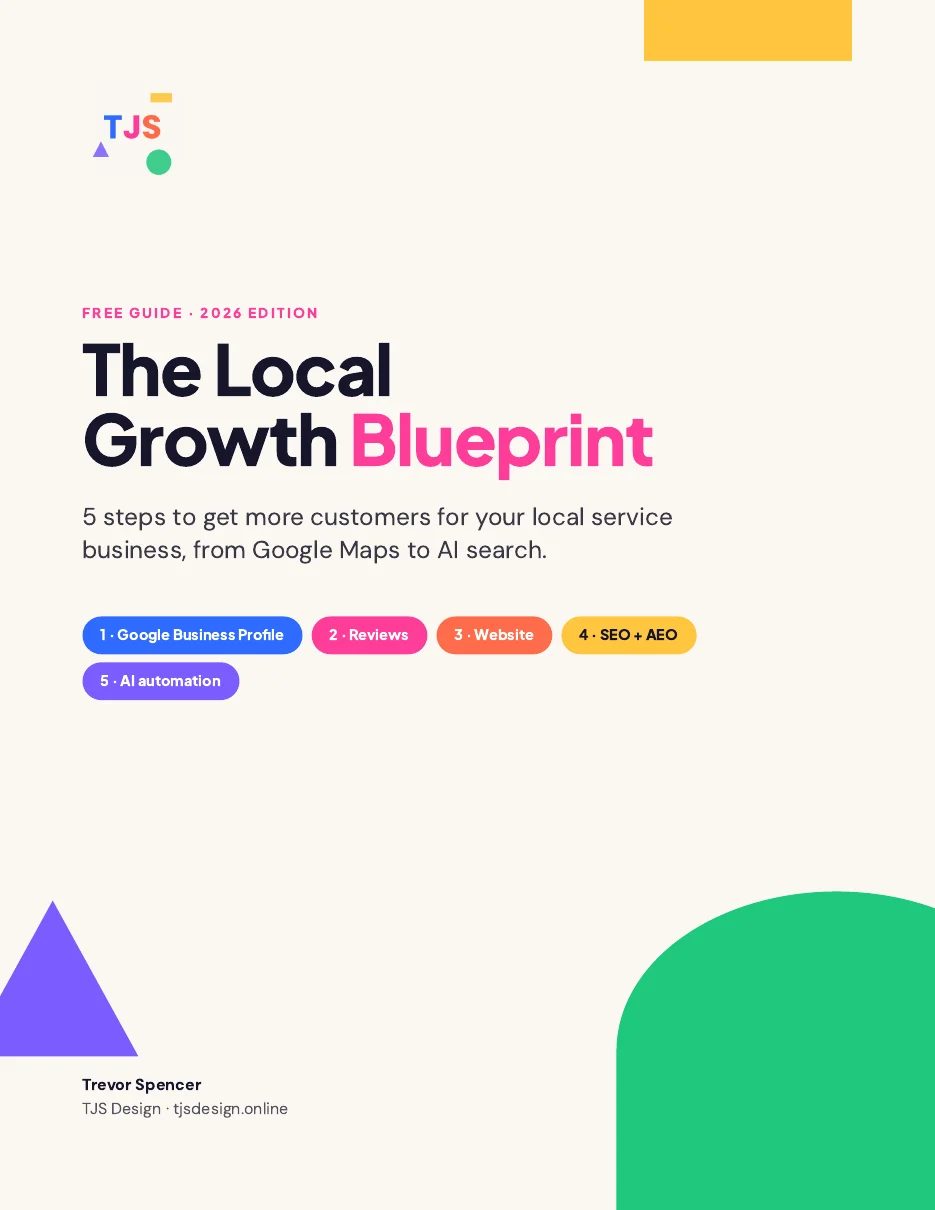
Cover of The Local Growth Blueprint, a free guide from TJS Design
Free download

Get The Local Growth Blueprint

The full playbook behind the video, in 14 pages you can work through yourself:

  • A 2-minute scorecard to see where you stand
  • Step-by-step walkthroughs for all 5 steps
  • Copy-and-paste review requests and reply templates
  • A homepage blueprint that turns visits into calls
  • A 30-day action plan and progress tracker

No spam. I'll send the guide and an occasional useful tip; unsubscribe anytime. See the privacy policy.

You're in. Here's your guide.
Download the PDF (14 pages)

Start with the scorecard on page 3. Questions? Call or text me at (385) 472-3690.

The written version

The 5 steps to get more local customers

Every month, hundreds or even thousands of people in your area search for exactly what you do, on Google, on Google Maps and increasingly in AI assistants like ChatGPT. Most of them hire one of the first few businesses they find. These five steps decide whether that's you.

1

Build a complete Google Business Profile

Short answer: claim and verify your free Google Business Profile, fill in every section, add real photos, turn on chat, and post every week. It's the listing customers see first in Google Maps and local search results.

Google shows the businesses it's most confident about. A complete, active profile gives Google more reasons to show you and gives customers more reasons to call.

  • Pick the most specific primary category ("Plumber," not "Contractor"). It's the most important setting on your profile.
  • Set your service area if customers don't come to you, and keep your business name free of extra keywords.
  • List every service with a short description, and fill in hours, phone, website and a professional email.
  • Upload 20+ real photos of your team, trucks and finished work, then keep adding a few every month.
  • Turn on chat by adding a text or WhatsApp number in your profile's contact settings, so customers can message you from Google.
  • Post weekly: a finished job, a seasonal tip or an offer. AI tools make a steady schedule easy to keep.
2

Collect reviews on a steady schedule

Short answer: Google ranks local results on relevance, distance and prominence. Reviews drive prominence, so ask every customer for a Google review right after the job and reply to every review.

Your total number of reviews and your star rating both matter, and local SEO experts consistently find that a steady flow of recent reviews helps too. A business that got a review last week looks more alive than one whose last review was a year ago.

  1. Copy your review link from the "Ask for reviews" option in your Google Business Profile.
  2. Text it to every customer the same day, while they're happy.
  3. Thank happy reviewers by name; answer unhappy ones calmly and offer to fix it offline.
Don't break these rules
Never pay or offer discounts for reviews, never ask only happy customers, and never post fake reviews. Google can suspend your profile, and the FTC can fine businesses for fake reviews.
3

Link a website that turns visits into calls

56%
of customer actions on a Google Business Profile were website clicks, more than calls or direction requests. BrightLocal study of 45,000 business profiles

If there's nothing there, or a page that looks like 2009, people go back and tap your competitor. Your website should:

  • Say what you do and where in the first headline.
  • Put tap-to-call, text and booking buttons at the top of every page.
  • Give each main service its own page, and list your service area plainly.
  • Show proof: reviews, before-and-after photos, licenses, insurance and guarantees.
  • Load fast on a phone. Test it at pagespeed.web.dev.
  • Match your Google Business Profile's name, address and phone exactly.
4

SEO and AEO: get found on Google and in AI answers

Short answer: SEO (search engine optimization) helps your website rank on Google and Bing. AEO (answer engine optimization) helps AI assistants like ChatGPT, Gemini and Google's AI Overviews understand your business and recommend it when someone asks a question.

What is local SEO?

Local SEO is making your website and listings easy for search engines to match to local searches like "water heater repair near me." It comes down to four things:

  1. The right keywords. Use Google's autocomplete, the "People also ask" box and the search terms in your Google Business Profile's Performance report to learn how customers search. Pair each service with your cities.
  2. Clear page structure. One main topic per page, with the keyword in the page title, main headline and first paragraph.
  3. Proper indexing. Submit your sitemap to Google Search Console and Bing Webmaster Tools so both actually index your site. Bing matters more than you'd think: several AI tools draw on its results.
  4. Structured data and consistent listings. Add LocalBusiness schema (or a specific type like Plumber or RoofingContractor), and keep your name, address and phone identical on Bing Places, Apple Business Connect, Yelp, Facebook and Nextdoor.

What is AEO (answer engine optimization)?

More customers now ask AI assistants things like "Who's a well-reviewed roofer near me that does free estimates?" Those tools pull answers from websites, listings and reviews. AEO means making your information easy for them to find, understand and cite:

  • Answer real questions in plain language, with an FAQ on each service page: prices, timing, estimates, service area.
  • Lead with the answer. Put a direct one- or two-sentence answer first, then the details.
  • Publish the facts AI tools look for: services, price ranges, hours, response times, warranties, licenses and years in business.
  • Mark it up with schema so machines can read it reliably, and keep it consistent everywhere.

SEO vs. AEO at a glance

SEOAEO
GoalRank in search resultsGet named in AI answers
Where it showsGoogle, Bing, Google MapsChatGPT, Gemini, Grok, Google AI Overviews
What it rewardsRelevant pages, keywords, links, indexingClear direct answers, structured facts, consistency, reviews
How you winService + city pages, sitemap, schemaFAQs, plain-language answers, accurate details everywhere
Try this today
Ask ChatGPT, Gemini and Google: "Best [your service] in [your city]?" Note who shows up and what details the answers mention. That's your to-do list.

Google's CEO has described the future of search as an "agent manager": AI that doesn't just answer questions but gets things done. New standards already let AI assistants book appointments straight through a business's website. All of it plugs into one foundation: a real website on your own domain, full of clear answers about your business.

5

Put AI to work in your business

Short answer: AI assistants can answer texts, emails, website chats and even phone calls, and book appointments, so you stop losing jobs while you're busy. Start with one piece, like after-hours text replies.

  1. After-hours text replies: an instant answer that offers to book a time.
  2. Website chat: trained on your services and FAQs, with a handoff to you.
  3. Phone answering: an AI receptionist for overflow and after-hours calls.

Always offer a way to reach a person, review what the AI says, and follow consent rules before sending marketing texts.

+

Bonus: social media and Google Local Services Ads

Everything above is organic and costs very little to run. Share the same photos and posts on Facebook, Instagram and Nextdoor. Once the basics work, Google Local Services Ads put you at the very top of Google with a "Google Verified" badge, and you pay per lead instead of per click. Fix your profile, reviews and website first, so the people you pay for actually call.

Want all of this as a checklist with templates?

Get the free guide →
FAQ

Common questions, straight answers

What is the difference between SEO and AEO?

SEO (search engine optimization) helps your website rank in search results like Google and Bing. AEO (answer engine optimization) helps AI assistants like ChatGPT, Gemini and Google's AI Overviews find, understand and recommend your business when someone asks a question. Most of the work overlaps: clear service pages, consistent business details, structured data and direct answers to common questions.

How do Google local rankings work?

Google ranks local results on three factors: relevance (whether you offer what was searched), distance (how close you are to the searcher) and prominence (how well known and trusted you are). Reviews, a complete Google Business Profile and a strong website all feed prominence.

Do I need a website if I already have a Google Business Profile?

Yes. In a BrightLocal study of 45,000 business profiles, 56% of customer actions on a profile were website clicks, more than calls or requests for directions. Without a website, those people go back to the results and pick a competitor. A website also gives search engines and AI tools the detailed information they need to recommend you.

How many Google reviews does a local business need?

There is no fixed number, but you want more reviews than the businesses ranking above you, a strong average rating, and a steady flow of new ones. Ask every customer right after the job by texting your Google review link, and reply to every review.

How long does local SEO take to work?

Fixes to your Google Business Profile can show results within weeks. Website SEO usually takes a few months to build, depending on your competition and how much content you publish. Reviews and weekly profile posts compound over time, so consistency matters more than speed.

What are Google Local Services Ads?

Local Services Ads are paid listings at the very top of Google, marked with a Google Verified badge. You pay per lead rather than per click, and Google checks details like your license and insurance before you can run them. They work best once your profile, reviews and website are in good shape.

Is the Local Growth Blueprint really free?

Yes. The 14-page PDF guide is free. Enter your name and email on this page to download it. It includes a self-assessment scorecard, step-by-step walkthroughs, copy-and-paste templates and a 30-day action plan.

Read the full video transcript

0:00Right now, someone in your town is searching for exactly what you do. "Plumber near me." "Roof repair." "AC fixed today." The only question is whether they find you, or the next guy. So here's exactly what I'd do if I ran a local service business today to get more customers. Five steps.

0:20Every month, hundreds, or thousands, or even tens of thousands of people search for your exact service, depending on your trade and your town. Even if you've got great repeat customers, that's growth sitting on the table. And the front door to all of it is your Google Business Profile.

0:37Step one: fill out your profile, all of it. Your services, hours, service area, phone number, a professional email, and a link to your website. Add real photos: your crew, your trucks, your finished work. A profile with lots of photos looks busy, and busy looks trustworthy. Turn on the chat option so customers can text you straight from Google. Then post to it every week: a finished job, a seasonal tip, an offer. Google rewards profiles that stay active. And with AI tools, keeping a steady posting schedule has never been easier.

1:13Step two: reviews. Google ranks local results on three things: how relevant you are, how close you are, and how prominent you are. Reviews are a big part of prominence. That's your total number of reviews and your star rating, and local SEO pros consistently see that steady, recent reviews matter too. A business that got a review last week looks more alive than one whose last review was a year ago. So make asking for a review part of every job you finish.

1:43Step three: a real website, linked right to that profile. In a study of 45,000 business profiles, more than half of all customer actions were website clicks, not calls, not directions. If there's nothing there, or a page that looks like 2009, they hit back and tap your competitor. Your site should load fast, look great on a phone, and make it dead simple to call, text, or book.

2:10But a website only works if people can find it. That's search engine optimization: the right keywords for your services and your city, clean page structure, a sitemap, and making sure Google and Bing have actually indexed your site. Then there's the newer piece: answer engine optimization, or AEO. More and more customers ask ChatGPT, Gemini, or Grok things like, "Who's a well-reviewed roofer near me that does free estimates?" AEO means structuring your site so those AI tools can read your services, pricing, service area, and hours, and cite you as the answer.

2:49And here's where it's all going. Google's CEO has described the future of search as an "agent manager": AI that doesn't just answer questions, but gets things done for you. New standards are already rolling out that let an AI assistant book an appointment straight through your website, without the customer ever opening it. But all of that plugs into one thing: a real website, full of real answers about your business. Build that foundation now.

3:16Step five: put AI to work inside your business. Today an AI assistant can answer your texts and emails, reply to chats on your site, and book appointments. It can even answer the phone in a voice that sounds like you. You don't need it all on day one. Start with one piece, like answering after-hours texts. AI isn't here to replace you. It's here so you never miss a customer while you're on a job.

3:42Finally, tie it all together with social media: the same photos and posts, shared everywhere your customers scroll. Everything so far is organic, and it costs very little to run day to day. Once it's working, paid ads put you in front of even more of those searches. For most trades, the best first step is Google's Local Services Ads: the listings at the very top with the "Google Verified" badge, where you pay per lead instead of per click.

4:10So: a complete profile, steady reviews, a real website, SEO and AEO, and AI handling the busywork. You can absolutely do all of this yourself. That's why I made this video. If you'd rather have someone handle it for you, that's what I do at TJS Design. Either way, go get found.
Rather have it done for you?

A custom website built for local search, in under 14 business days

Fully custom, mobile-ready, with SEO, AEO, Google and Bing indexing and analytics set up for you, then managed for you. Plans from $0 down. One expert, start to finish.